
Visiting the site of my family’s old home on Hull Street in Detroit isn’t currently an option for me. Instead, I spend a fair amount of time scanning images from Google Streetview like they were crime scene photos, looking for evidence of our prior history.
Another family story: My great-grandfather Zvonimir* Brovet once rescued some pine trees that had been damaged in a fire and left for trash. He dragged them back to the yard on Hull and Stender and replanted them, where they grew for many years. In my dad’s words: “One blue spruce, two half burned pines, placed side by side with burns touching, giving appearance of one big double-headed pine tree. Huge lilac bush in between the spruce and pines.”
The house is gone, but maybe not everything is gone.
If you click through the Streetview images of adjacent Stender Street, and pick just the right angle, you’ll suddenly see two pine trees roughly at the edge of what used to be the Hull Street backyard. They’re spindly and spare, with bare eastern sides. Their remaining branches stretch back like the arms of kids with their faces in the wind.

I eagerly texted a screenshot of the trees to my Aunt Janice. Could these be his?
“No. They were at the back of the property and the alley was right behind them,” she answered. I scanned the angle again wistfully. The alley never got paved—is it that interruption in the grass? Is that branchless tree in the distance a spruce, or a coincidence? The answers are 290 miles and 10 decades from here.
So maybe those aren’t Zvonimir’s pines. But I like knowing that he would rescue trees from the trash. Zvonimir had grown up among forests. And he himself had been transplanted, more than once.
Boy, Barber, Soldier (1889-1907)
My great-grandfather has long been the most elegant of mysteries to me, due to this one photo. It probably dates from around 1912, when Zvonimir (a Croatian) was serving in the Austro-Hungarian army. Despite contacting the state archives of Austria, Hungary, and Croatia, I’ve been unable to find any records of his military years. The picture is all we have.

His life before that is similarly hazy. While his wife Rose was a product of farm life, Zvonimir was not. His hometown, Čabar (pronounced CHA-bar) lies among forests on the Croatian/Slovenian border, at the top end of the Dinaric Alps. There were iron mines and lumber mills, but limited land for crops. Among his family tree I’ve found artisans, watchmakers, and cobblers, but almost no farmers.


Instead, he was probably a child of town and woods. He was born fourth of five to his parents Ivan and Cecelia. Ivan had been a roofer, but by Zvonimir’s birth in 1889 he was a K&K postmaster (Kaiserlich und Königlich, or Imperial and Royal) in the town of Prezid. As a civil servant working for the Austro-Hungarian empire, he would have enjoyed secure employment and a guaranteed income.

Whatever woods Zvonimir explored or hills he climbed in childhood, he got little time to enjoy them. Once he turned 12, he was sent to a trade school Karlovac to become a barber’s apprentice. His brothers were similarly apprenticed, to an accountant and a butcher or maybe baker. I don’t think any of them got much say in the matter. I once asked my grandfather if he had wanted to also be a barber like his dad Zvonimir. His answer: “My dad told me, ‘If you become a barber, I’ll cut your fingers off.’”
Two years after that, his father died, and childhood was over.


Above: Zvonimir at trade school in Karlovac, c. 1901. Postcard of Karlovac in 1902. Clip from the Seattle Post-Intelligencer; June 8, 1913.
Soldiering had always been in Zvonimir’s future: The Austro-Hungarian empire instituted mandatory conscription in 1868, so he likely joined the army sometime before his 21st birthday. He served for two and a half years, overlapping with a 1912 change that dropped the required minimum service from three years to two. I suspect he left as soon as he could.
Even without records, that photo of his uniform holds a few clues. He appears to be wearing a parade uniform of the Royal Hungarian Landwehr, which included the Royal Croatian Home Guard. His attila-style jacket would have been blue, like his eyes, while the three stars on his collar could mean a lieutenant’s rank. The striped pants may be ceremonial, or they could indicate cavalry service in the Hussars.
His waxed mustache and uniform make Zvonimir a striking figure—but his eyes are wary, as if he wasn’t ready for the shutter to click. I feel for him: He’s young, but he’s already spent half his life as a barber or a soldier. All of his immediate family have left the country. He wears the uniform of a fading empire that he wants no part of.
The camera freezes him to the moment, but his foot is a blur. He is already in motion.
Hegewisch (1912-1915)
In the last month of 1912, Zvonimir stepped off a ship in New York City. He would never go back to Croatia, but in a way he didn’t need to—his family was already here. His oldest sister Mary had arrived in the US first, in 1905, followed by their sister Fannie and then their widowed mother Cecelia. The women spent five years living and working in New York before the men ever arrived.
When Zvonimir’s brothers Frank and Emanuel eventually immigrated, they aimed for Chicago, one of the most popular cities for Croatians. By 1912 the family was renting a little house in the pocket neighborhood of Hegewisch, where the edges of Chicago and Indiana fray together.


The house, at 13410 Houston St., still stands. According to Zillow it is a cozy 680 square feet. It must have been a snug reunion that Christmas, with the whole family together for the first time in nearly a decade. When Zvonimir arrived, the household was Mary and her baby son George, siblings Fanny and Emanuel, and their mother Cecelia—and possibly brother Frank and his new wife.
The joy of reconnecting was short-lived: Cecelia died of kidney disease just two months later. But Zvonimir at last had the freedom to make some choices. While his brothers were working in railcar factories, Zvonimir made a serious go at barbering.
In April 1913, I think he ran a job-wanted ad in the Chicago Tribune (likely with Frank’s name because he spoke better English). It’s interesting that he doesn’t mention Croatian at all, but instead speaks German and Austrian (which could mean Croatian, or could be an Austrian dialect like Viennese). He would later place ads in Polish newspapers, indicating that he eventually spoke at least 3 languages—Croatian, German, and English—and possibly even 5.

That summer, two blocks from the Houston St. house, a tailor shop went up for rent. Whatever his feelings about barbering, Zvonimir had decided to start his own business.


One photo still exists. The place looks respectably well equipped with two chairs, a shoeshine stand, and humorous signs on the wall. He looks as poised in this uniform as he did in the earlier one, maybe even a little defiant. He might been ambivalent about barbering, but he was succeeding at it.


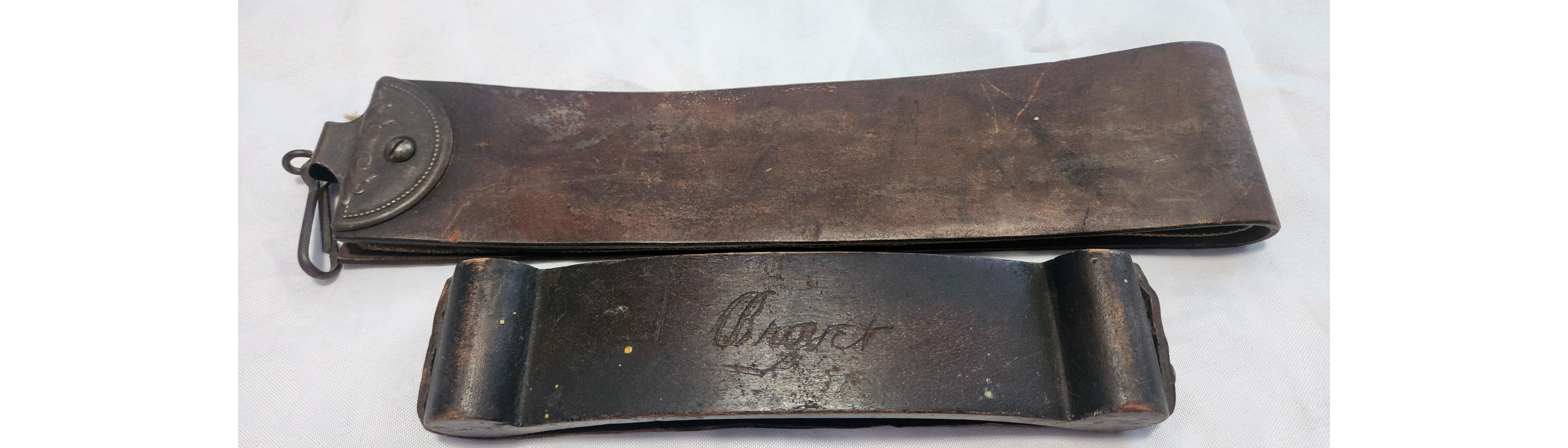
Above: Zvonimir’s tools and supplies. Scissors, razors, combs, styptic compounds, pomades, sharpening block, and brush. The image at the top of this post shows his razor strops.
****
1914 offered multiple reminders that while Croatia was far away, being Croatian, with all the ups and downs that come with belonging to a community, was part of Zvonimir’s everyday life.
Early in the year, Zvonimir and his family had to cope with the scandal around that other Frank Brovet. I now know this was not about Zvonimir’s brother Frank, but probably a cousin who had recently immigrated. However Zvonimir reacted to this situation, he could not have escaped it. Their family name was in the newspaper. His brother Emanuel was the informant on the death certificate. There was a cost to be paid not just in shame, but in real dollars. The family had buried their mother Cecelia only a year earlier, and here again was the unwelcome expense of death. Someone had to pay the undertaker and arrange for a gravesite. They did not buy a headstone.
Croatians were already well established around Chicago and Gary, with their own grocery stores, orchestras, newspapers, and political organizations. When war erupted in the second half of the year, it immediately animated the Croatian community. The rallies—and for some, plans to return and fight for the homeland—started as soon as the war did. Some hoped the war would mean Slavs could unite as one nation free of the Kaiser’s authority. (Based on events in later years, I think Zvonimir hoped for this, too.)
Others felt building pressure to prove their Americanness, particularly keen for those who had newly adopted it. Zvonimir was among them; in April, he signed his formal declaration to become a citizen.


At least the barbershop on Brandon seems to have been thriving. In August 1914, Zvonmir even had to advertise for more help: “GOOD BARBER NEEDED. $12 weekly. Apply immediately to Z. Brovet, 13302 Brandon Ave., Hegewisch.”

Dziennik Chicagoski; Chicago, IL. Aug. 6, 1914.
And yet, by April 1915, the shop was for sale. Other plans were taking precedence. Even his name was changing, from Zvonimir to the more-Americanized Benjamin, complete with a middle initial.


Rose

Community could bring benefits, too.
Rose once claimed that she met Zvonimir in the most charming way: They were both at a Croatian meeting where the audience was seated on folding chairs. She was in the row behind Zvonimir, and when she rested her foot on his chair, it collapsed under him. He turned around to see who had broken his chair. (I’ve also heard they met in a park, but the folding chair makes a better story.)
However they began, their future wasn’t entirely up to them. Rose was a young unmarried woman, and her brother Joe was her de facto parent in the United States. Without his approval no relationship would go forward. Fortunately for all of us, he did.

☗
*Pronounced ZVOH-ni-meer or ZVAH-ni-meer.
© 2026 Tori Brovet/All rights reserved. Email me at GraveyardSnoop @ gmail.com.
Leave a Reply