I.
If you’re looking for excellent watchable genealogy how-to videos, you would be hard-pressed to find better than Jen Shaffer, the Formidable Genealogist. We’ve never been introduced, but for some time I’ve been watching her do the good work her job requires…and get unwarranted grief for it.
Earlier this spring she debunked the popular myth about immigrants’ surnames being forcibly changed at Ellis Island. (And yes, it’s a myth; I’m not entertaining a debate.) Many families have this legend: Your flatcap-wearing great-great grandpa walked off the boat in New York and told them he was Wiśniowiecki or Kovačević or Bellincioni. But then an evil immigration officer changed Grandpa’s name to something “more American”—Weck, Kovak, Bello, etc. Poor Grandpa didn’t even have a choice.
Except that’s not how officers got your name at Ellis Island.* Officers didn’t have the time or the inclination to assign new names to hundreds of immigrants every day. They were handed a manifest from the boat and they matched arrivals to it.
If your surname truly was altered—and just settling on one spelling doesn’t count as a name change—it’s because your ancestor themselves changed it, usually well after they arrived in the United States.
Ms. Shaffer’s been patiently explaining all this to people. Most come away understanding, but others refuse to listen, beyond the point of rudeness. God bless her: Every time I see this come up, I want to get her a soothing drink and a quiet space away from people who say they want The Truth, but will really only settle for their truth.
II.
Modern Americans think of name-identity like a tattoo: Permanent from the start; stuck to your very being; hard to change; and even if you do, the remnants can still be found.
In fact, this whole concept of an indelible, unchanging name-identity is a modern invention. It’s mainly the end product of more consistent record-keeping and a more literate populace that expected reliable spelling. For most of history, your name-identity was closer to wearing a coat: It was put on you, but you could alter it to fit, or you could even change it to something else altogether.
Just ask Lady Bledzo. Or as she was also known: Lenoir Barnett; Rose Bledzo; Lady Rose Bledsoe; Lady Rosa Bledzo; Rose Leonora; Leonore Bleedson; Eleanora Bleedson; and twice, Lenor Grear. Life in the 19th and early 20th centuries allowed for such personal fluidity. (In her case, required it.)
For sure, there is a gulf of differing intent between an immigrant who opts for one name spelling and a crook avoiding the law. But for me as a researcher, there isn’t much difference at all.
My focus on scam artists, performers, and others outside the mainstream means I run into this fluidity more than most. In my file of current research projects is a fraudster and her paramour who, between them, have 24 aliases.
Twenty-four.
Coats, not tattoos, I keep muttering under my breath as I put yet another possible name in the search engine box.
III.
I was reminded again this month as I tried to sort out the life of a performer named Elsie Stirk.
Elsie deserves, and eventually will get, her own place on this blog. But in brief: Elsie was a 1900s vaudeville performer who worked as a female impersonator, and specialized in impersonations, voices, and trapeze stunts. Later she moved to carnivals as a “half-and-half” act—half man/half woman.

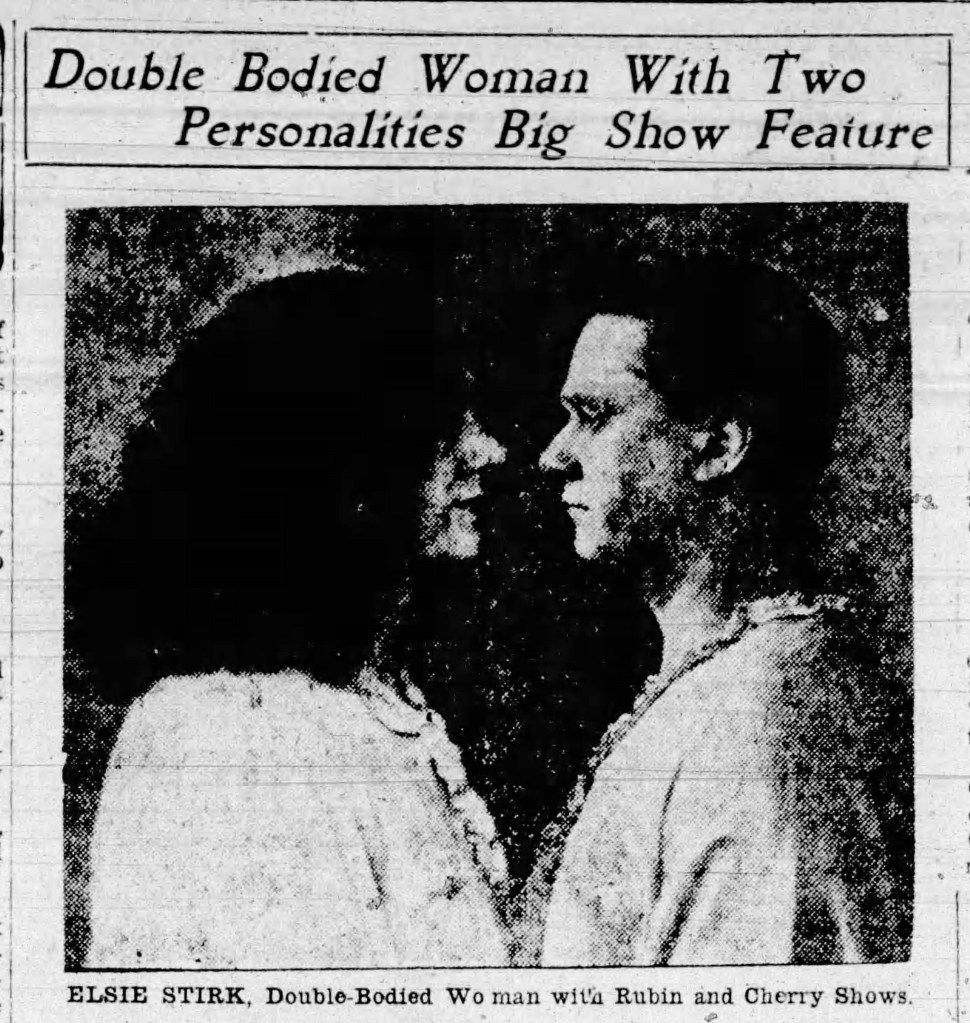
The name “Elsie Stirk” was an alias. She appears to have taken it from an earlier “Elsie Stirk” who was also a performer—but in a family bicycle act in 1890-1910. I think of them as Vaudeville Elsie and Bike Elsie.
And yet it was almost certainly by design, akin to an up-and-coming performer naming themselves “John Travolta.” More than once, newspapers assigned Bike Elsie and her famous family history to Vaudeville Elsie, giving her a background she didn’t have.
So now, as I work, I have to sort historical references about Vaudeville Elsie from those about Bike Elsie.
Bike Elsie appears in digital archives only a few times, as part of a larger family bicycle troupe called the 7 Stirks (or 5 Stirks or 9 Stirks, depending on the period).
The bicycling Stirks themselves were a creation of their founder Thomas Stirk, whose name is thankfully legit. Along with his wife Flora (actually Sarah), they and their many children crisscrossed the country for years, performing in small towns and large cities as part of various circuses.

Except… I think only two of the Stirks “children” were theirs: a daughter Flora and a son Charles. All of their other children seem to have been actors who only took the Stirk name while they were part of the act. Flora herself told the 1900 census that she only had 2 children. So even the Bike Elsie/Elsie Stirk was probably an alias for that person.
Various Stirk “children” mentioned in ads and articles over the years:
- Christie
- Elsie
- Ethel
- Fred
- George
- Granell
- Gussie
- Lottie
- Nettie
- Nora
- Denny (actual name: Dennis Moore)
- Flora (confirmed biological child)
- Charles (confirmed biological child)
- Viola
- Reata
If that wasn’t enough—and my gosh it already IS more than enough—there was a third performer in the 1920s. Also a female impersonator, named Elsia Baker.
Or when she was using her husband’s name…Elsia Stirk.
Believe it or not, these are three different people: Bike Elsie Stirk, 1880s-1900; Vaudeville Elsie Stirk, 1900s-1930s; and Elsia Stirk, 1920s, mostly in Australia.
And yes, this means the original Elsie Stirk was probably a creation, copied by the second Elsie Stirk, and the third Elsie Stirk was a coincidence.
Coats, not tattoos. ☗
*Or Baltimore. Or New Orleans. Or Boston.
© 2025 Tori Brovet/All rights reserved. Email me at GraveyardSnoop + gmail.com.

 Graveyard Snoop