Candy, Baseball, Alcohol

Planning the big genealogy trip that I’ve been talking about for years.

“The profession of “fact-finding“ is mostly encountered in companies where people are sent to investigate. … From an artistic point of view, fact finding is about working with first-hand experiences, not with references. The important thing to keep in mind is that the truth is not the ultimate goal in this process.” — Alex Bodea, operator of The Fact Finder art gallery

This spring we finally made it back to New York and Brooklyn. It was the first time my husband and I had managed to get there since 2019, with two cancelled attempts between then and now. It was far past time.

Unlike our previous trips, this time I planned no genealogy activities. I wanted this visit to be purely vacation. So no to archives, libraries, or spontaneous research sidetracks that erode people’s patience and time. Yes to museums and tea shops and bakeries. Yes to getting a slice, and a detour to Coney Island. Yes to an Italian restaurant that felt very much like being at someone’s house. Yes to a trip about life, not the dead.

We did visit a cemetery, but one without any of my people in it. It was fine.

And yet.

On our way to LaGuardia I caught sight of the old Domino Sugar factory, and thought wistfully again about Benjamin Huppler. My 3x great-grandfather, he was a Swiss confectioner who ran a candy shop in Brooklyn for many years.

As I’ve mentioned, Brooklyn is the core of my proudest genealogy work. The borough was home for two of my great-grandparents, and the nebula of family around them. I knew none of this history while I was growing up—but without any documented history, this branch has been mine to explore. From the one name I started with I now have generations. I have brought entire people back to light, even the smallest and the forgotten. And while I’ve been able to uncover a few things about Benjamin Huppler, it’s never been enough.

My great-great-great grandfather.

I found myself saying out loud the thing that I’ve said on every single visit: “I should just spend a week here, and just work on genealogy.”

This time my brain came back with: “You could DO THAT, you know?”

****

And my brain was right: I absolutely could. I’m lucky to have a generous vacation policy through my employer, so getting the time off is not a problem. I’ve traveled solo before. With some planning, the expenses could be managed. I can handle the MTA. The whole thing is entirely doable.

In the weeks since the idea crystallized, I’ve started to conceptualize what this trip might look like. I keep using that word for it, “conceptualize,” as if I were designing a jungle adventure for 100 people instead of a trip to archives and libraries for just one person, who is also me.
I’ve also told people that it’s a fact-finding tour, which sounds impressive, like I’m carrying a briefcase and fixing a crisis.

But after reading that Bodea quote, it fits. I’m going in person because while online research can be amazing, it’s nothing like standing in the church your great-great grandparents attended. In person, I can have the first-hand experiences that shift genealogy from research into time travel.

****

The Plan as it Stands

People-Focused: There are three particular relatives I want to know more about.

  • 3X great-grandfather Benjamin Huppler, the candymaker mentioned above.
  • Great-granduncle Gus Weinpahl. Semipro ball player in Brooklyn, Sayville, and Connecticut, from about 1895-1910. He later went on to run his own candy shop and then a café. I bet he had a time.
Gus Weinpahl
Gus
  • Gus’ father and my great-grandfather Justus Weinpahl. German immigrant, Civil War veteran. Buried at Green-Wood. He operated a liquor-dealing business (like a wholesaler) for almost 40 years. My hunch/hope has always been that this kind of business could have put him in connection with government officials and also less savory types (Brothels? Bars? Race tracks?).

Hence my theme: “Candy, Baseball, Alcohol.” Because doesn’t that sound fun?

If I can’t learn about these men specifically, I want to know more about their worlds. Ideally, I am hoping to connect with some experts in these histories. I want to hire them for an hour so I can ask questions and learn more.

Location-Focused: On a broader family level, I want to visit some of the spots around Brooklyn that might have more resources than I can access online. That would be places like the Othmer Library, the church that I mentioned, and other places I can identify ahead of time. (And this time, I’ll be making strategic visits to investigate specific research items—no fishing expeditions.)

I may also take a day to go back to Green-Wood Cemetery and hunt down some of the graves that eluded me on my previous visits. With enough time, maybe I could visit TWO cemeteries.

That’s the strategy, for now. It occurred to me just today that I could probably also squeeze in a trip to the New Jersey town where my grandparents met. No doubt the plans will continue to shift as the months roll on.

****

The one thing I can’t plan—and don’t like to think about much—is what happens when this trip is done. I can’t imagine being done with Brooklyn, but if this trip is meant to answer some of my longstanding Brooklyn questions, what comes after that?

I also know that there is a finite amount of facts and information out there for me to uncover. What if I’ve already found most of it?

I have to go to find out. ☗


© 2024 Tori Brovet/All rights reserved. GraveyardSnoop — at — gmail.com.

You Can’t Save Everything

And really, should you try?

I’ve been going through The Boxes and trying to provide some coherence to a 10-decade salad of manuscripts, notes, photos, and letters. Acid-free sleeves and PVC-less binders are being employed. Photos are gradually moving into acid-free envelopes, and labels are being affixed.

Emphasis on gradually. It’s slow-going, and I’m already tired.

The whole process is slower precisely because of the disorder, and because of the randomness of what was saved by someone at some point. All those decision-makers are conveniently now dead, and I am left to make sense of their choices. No one can explain to me why they saved 50 blank postcards, but only one photo of my great-grandmother.

I hope they enjoy their waiting room, because it’s gonna be a while.

****

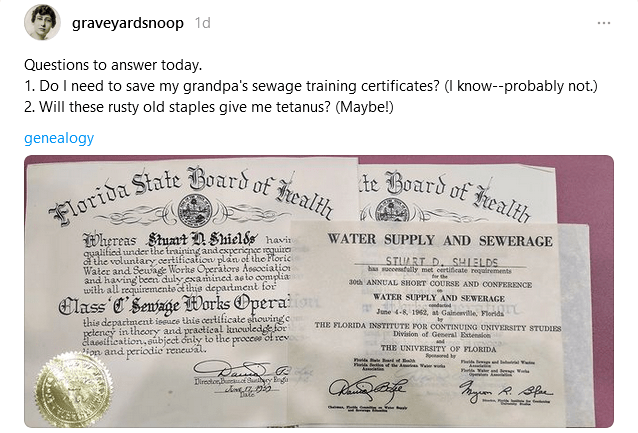
I alluded to some of this yesterday on Threads, asking out loud if I should save these sewage training certifications my grandfather earned in the 1960s.

The replies were pretty much unanimous: Save them! Scan them! Save everything! Save it for the future!

Here’s the thing (and this is not to slight anyone—everyone makes different choices)…

I appreciate the motivation and the thought behind “Save everything!” I genuinely do. There are things I WISH had been saved for me, and no one thought to do so. I wish that all the time.

Part of the reason I now have this mess in my living room, for good and bad, is because of people who thought they were saving everything. Which is why I had three drafts of the same family history, but no photos of people from an entire branch of the tree.

It’s also complicated because many of these papers were created by my great-grandfather, James K. Shields. He was the first family genealogist, but also a well-known pastor and Anti-Saloon League superintendent. And a writer. And for a short while he ran a movie company.

From him there are family history drafts, letters to Congress, notes for speeches, notes for things he wanted to put in books…None of it is complete, and all of it is unsorted. Or partly sorted. Or multiple drafts of the same writing.

The hard truth is, I don’t think all of it needs to be saved.

If you have a pile of unsorted papers and mail and photos in your house, picture that. Now imagine that stack gets stuck in boxes for decades, and then is handed off to someone born a hundred years after you. Yes, they would get an understanding of you, but would it be an accurate one? Would everything in the stack be worth saving forever? Would it all be worth the expense and time to scan or sleeve and store everything? And remember, it’s not your effort being expended—it’s that future person’s effort.

That is where I’m at.

****

As a childless person, hearing that I should save for future generations carries a particularly sad sting.

The very notion of passing down to your kids… is a privilege reserved for those who have kids. The rest of us are not so lucky.

This branch is my mother’s. She was an only child. Of her three children, I am the most involved in this work. I’m pretty much the end of the genealogists in our family, and the few people that are left—for reasons that are personal and private to them—are unlikely to be interested.

I am it.

If genealogy processes are going to stay relevant, they need to make space for people who don’t have children. Telling folks to save for future generations is not going to resonate for increasing numbers of people.

****

Some things, like my great-grandfather’s Anti-Saloon papers, I can find a place for. My task is to get those items into an archive. Those things can matter to many people.

But these sewage certificates only mattered to my grandfather Stuart, for a short while, and he died in 1975. I ultimately decided to keep them as proof of what a checkered professional life he had.

Stuart did not plan to be a sewage engineer. It appears to have been the fallback job after he was laid off from Pratt & Whitney in 1959, a move motivated by anti-union sentiment. So the sewage job was not wished for, and not long-lasting.

Further, from what I can tell, I think he did that sewage engineering at a notorious reform school in Florida. It was not a happily remembered situation.

Before that he worked for a tire company, trained as a chiropractor, and spent almost a decade as a window-dresser. He was all over the map.

So I’m saving them. But I also know I am probably the last person on the planet who will ever care about them. The value we imbue to objects and papers rarely outlives us, and that has to be OK.

I am learning to be OK with it. ☗


© 2024 Tori Brovet/All rights reserved. GraveyardSnoop — at — gmail.com.
Boxes and Bags and Threads

I have the rest of my mom’s family materials. It’s a lot to unpack.

Last week, someone asked me what genealogy projects I was working on, and I made the mistake of telling the truth out loud.

“Oh not much right now,” I said. “Some stuff has gone quiet, and other projects I’m dragging my feet on.”

I forgot that the ancestors were in the waiting room, and they could hear me. Because I also forgot that I was already planning to take back some boxes of stuff left from when my mom had died.

I sealed my own fate.

The boxes were more of the things I just could not deal with when we cleaned out her apartment. The boxes were hastily packed in 2018, and stashed in my sister’s garage since then. (That sound is a dozen professional archivists rolling their eyes in unison.)

This year, I felt like now was the time to retrieve them. So during my most recent visit we did just that. We dragged out the two boxes and reopened them on my sister’s dining room table for a quick scan and weed.

Yes, that is a tortilla bag.

Pretty quickly, I went from feeling “willing” to “burdened.” It wasn’t just the idea of two more large boxes of unsorted papers and photos from a dozen decades. It was that quite clearly, a significant amount of the photos had not been my mother’s at all. They had come from her last husband—they were HIS family’s photos. 

Which meant I would need to sort them from my mom’s photos, and then find his family members, who I haven’t spoken to since the early 1990s.

It felt like a Jacob Marley chain being laid on my shoulders.

But I also have to do this. I have a situation in my own family, involving photos I may never get to see. It has been a source of tremendous sadness to me. I just can’t do that to someone else.

We tossed a few things and packed it all up. I shipped some, carried some, and this past week I’ve been sorting it all out. Even if I had had time to sort it all in 2018, I couldn’t have. The larger of the two boxes was 28 lbs. of paper and photos. And my mother’s “filing system” was rudimentary at best.

The Stuff, a Partial List:

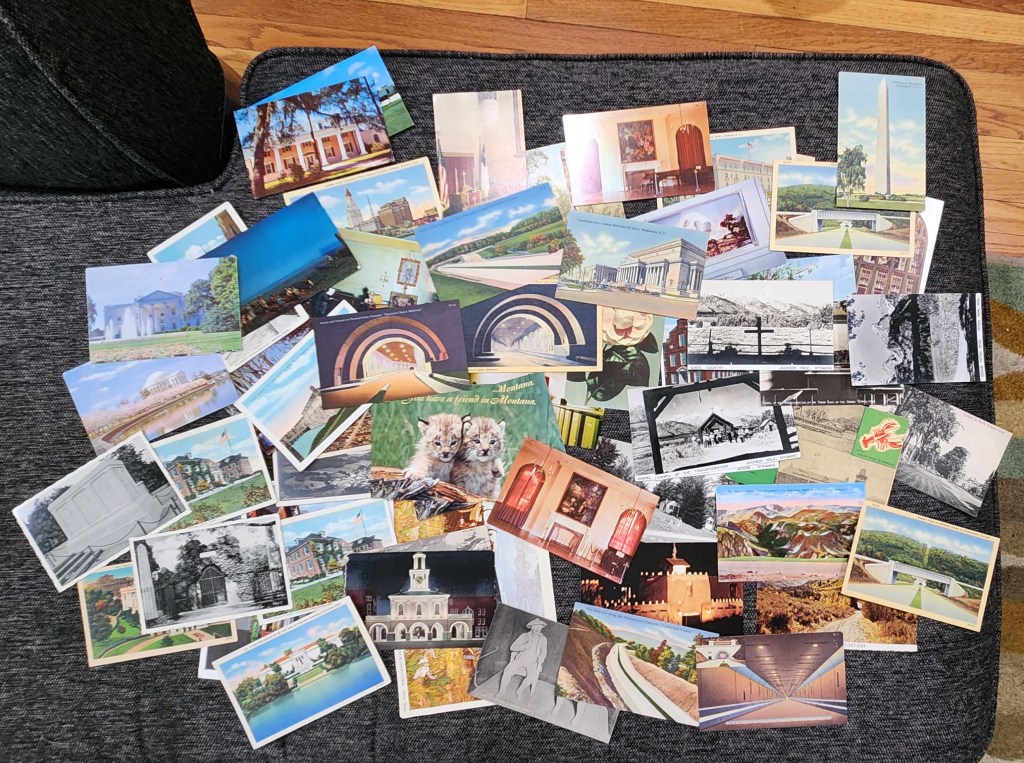
  • 59 blank postcards, 1900-2000s; everywhere from the White House to the Pennsylvania Turnpike.

  • About a dozen written postcards, including some from globe-trotting Aunt Edith. Also one slightly racy postcard my mom sent to her husband (ew).
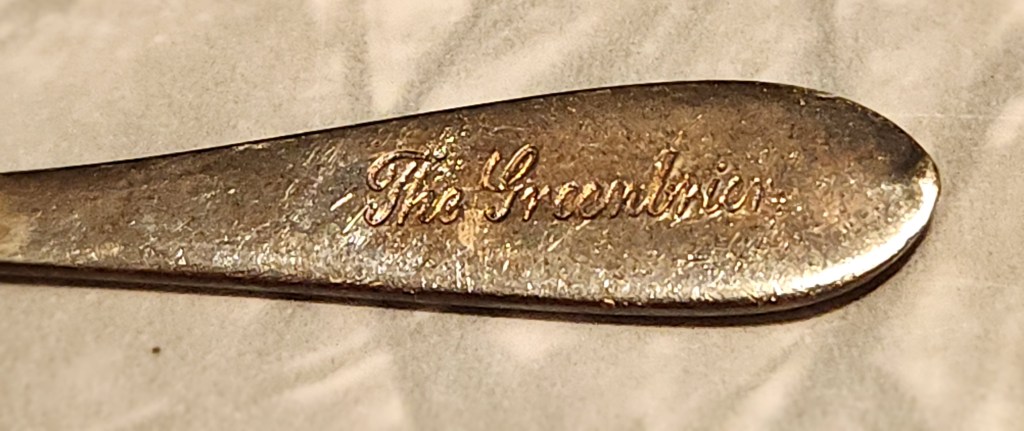
  • A spoon someone stole from the Greenbriar Inn. What!

  • A temperance pamphlet about Thomas Edison.
  • The mortarboard tassel from my sister’s law school graduation.
  • A resume my mom wrote, full of 100% lies about her qualifications and achievements. Definite keeper!
  • The quilt above, made by Edith’s sister Bessie, my great-grandma. I know: It has been in this condition for my whole memory.
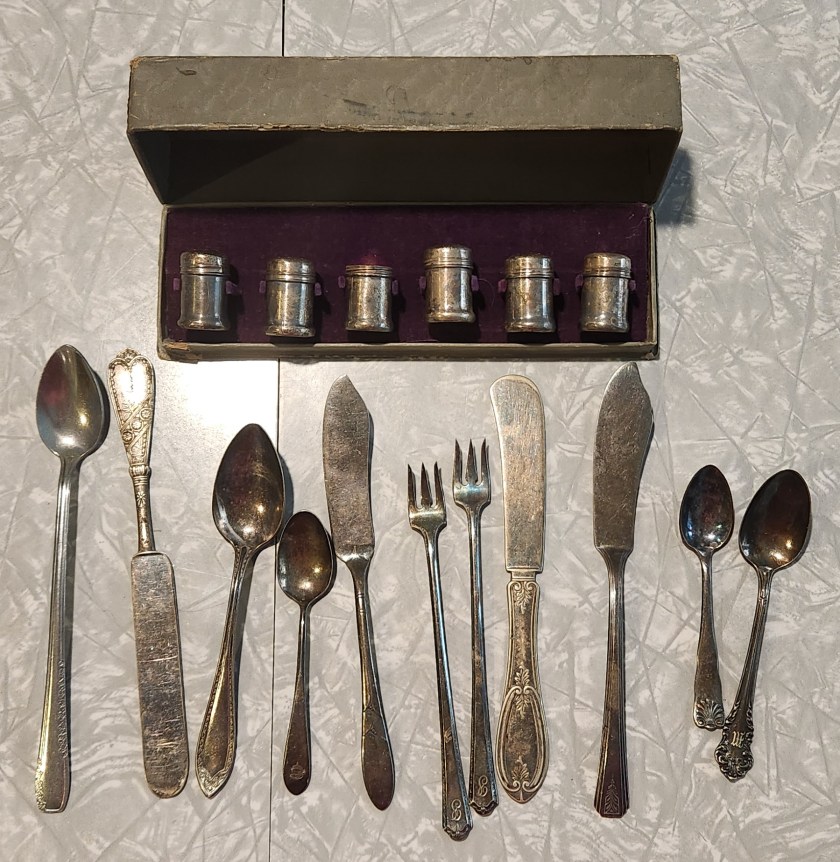
  • More old silverware to go with the old silverware we already weren’t using, as well as a set of mini silver salt and pepper shakers.

  • A full shoebox of photos from my mom’s last husband.
  • Six or eight files of genealogy notes written by my great-grandfather and his sons, on fragile onionskin and fastened with rusty paper clips. Sometimes they used shirt pins.

  • Memorial guestbooks from two funerals.
  • Photos, various, c. 1880s-2000s. Most unlabeled. Oh goody.
  • Letters, postcards, manuscripts. Some are important, some are not.
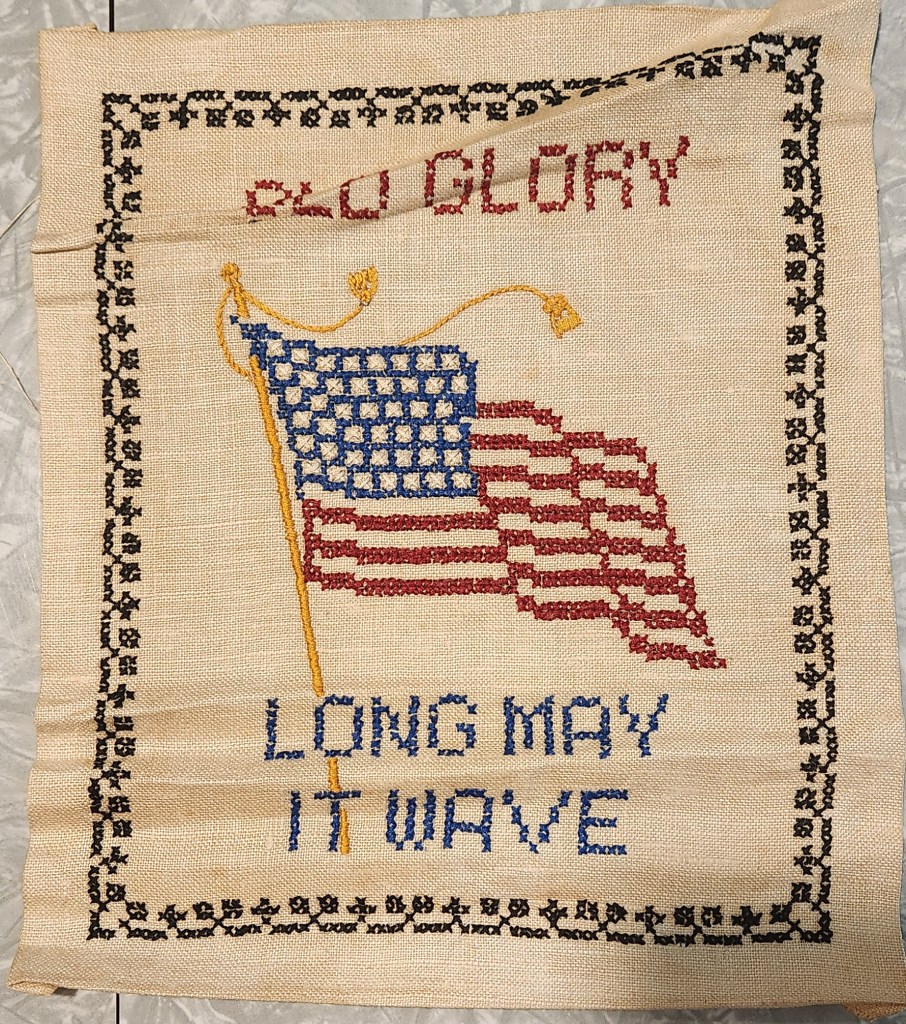
  • This sampler, which might be from WWI or could be from 1976. I have no idea.
  • This doll. Also have no idea.

The good news is that, with my husband’s help, I have already tossed two full grocery bags of stuff. I’m being ruthless with the weeding. Photos without people, photos without recognizable relatives, photos with recognizable relatives but terrible or blurry, a pile of greeting cards—they all go.

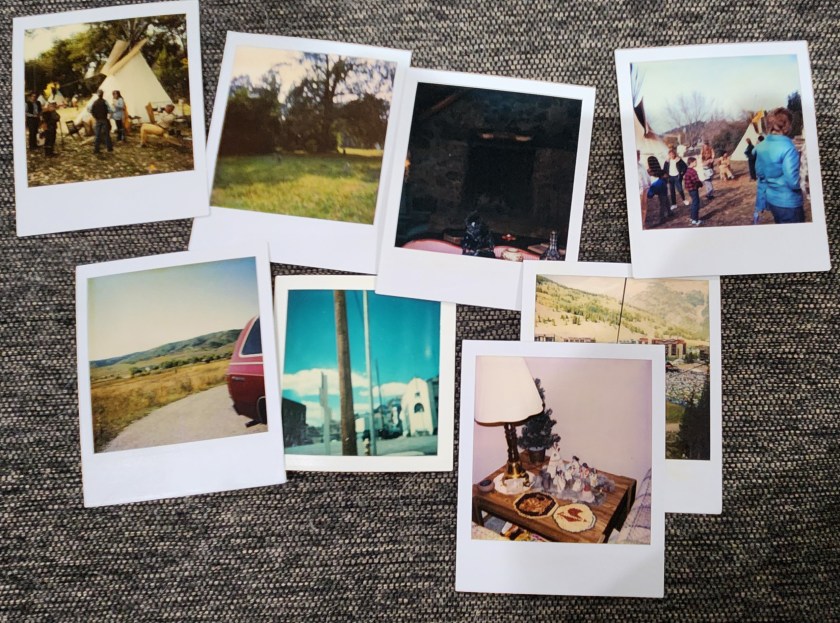
So many Polaroids of nothing and no one.

Nothing of value has been lost, so far. And now I can dig into what remains. ☗


© 2024 Tori Brovet/All rights reserved. GraveyardSnoop — at — gmail.com.

I Like Old Stuff: Kurtz’s Ledger

Among my family heirlooms is this ledger, which is basically a handwritten genealogy database.

Long before there was a Family Tree Maker or an Ancestry, my great grandpa used this to track his history.

Wayback Wednesday: Elise, Nancy, and Sarah

Elise, Nancy, and Sarah. 1946

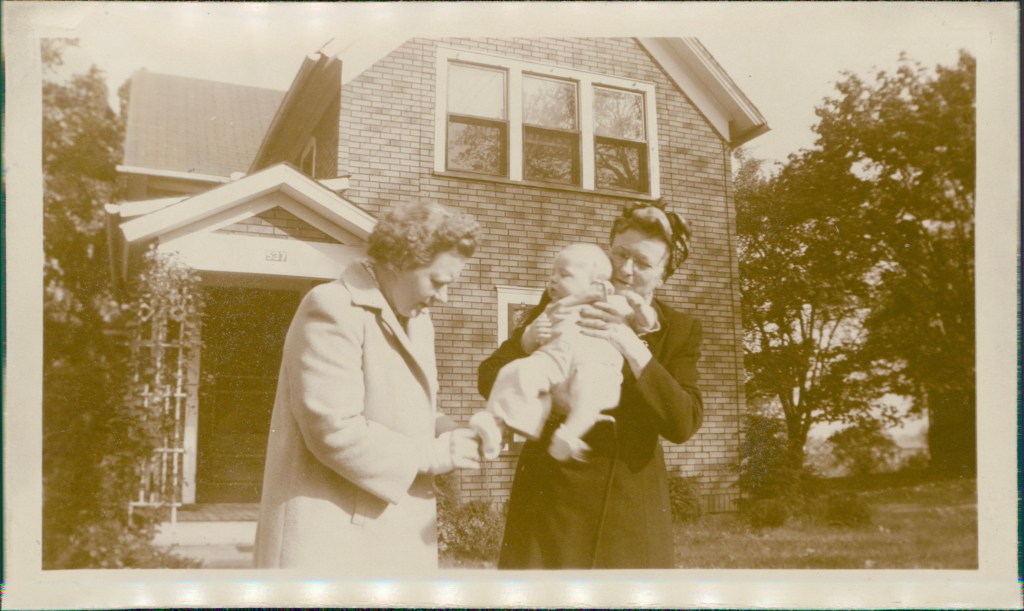
On Wednesdays we go way back. This week’s photo is my mom Nancy (the baby), between her mother Elise (left) and her grandmother Sarah (right).

I love unposed moments like this, when people were just being themselves. But I also can’t see it without some poignancy.

I know what they can’t: That Nancy would adore her grandmother, but struggle with her own mother, all their lives. She was caught between them here, and would be often as she grew up.

Sarah and Elise were actually stepmother/stepdaughter, and their own relationship was frosty.

There’s a lot of frustration in this photo. There’s a lot about love, mothering, disappointment, failure, and the ways we keep trying.